
How to Do Long Division
The short answerShare the biggest pieces first, and cut the leftovers into the next size down.
Premieres Wed, October 21, 4 PM PT
Watch on YouTube · Episode 008
What the video explains
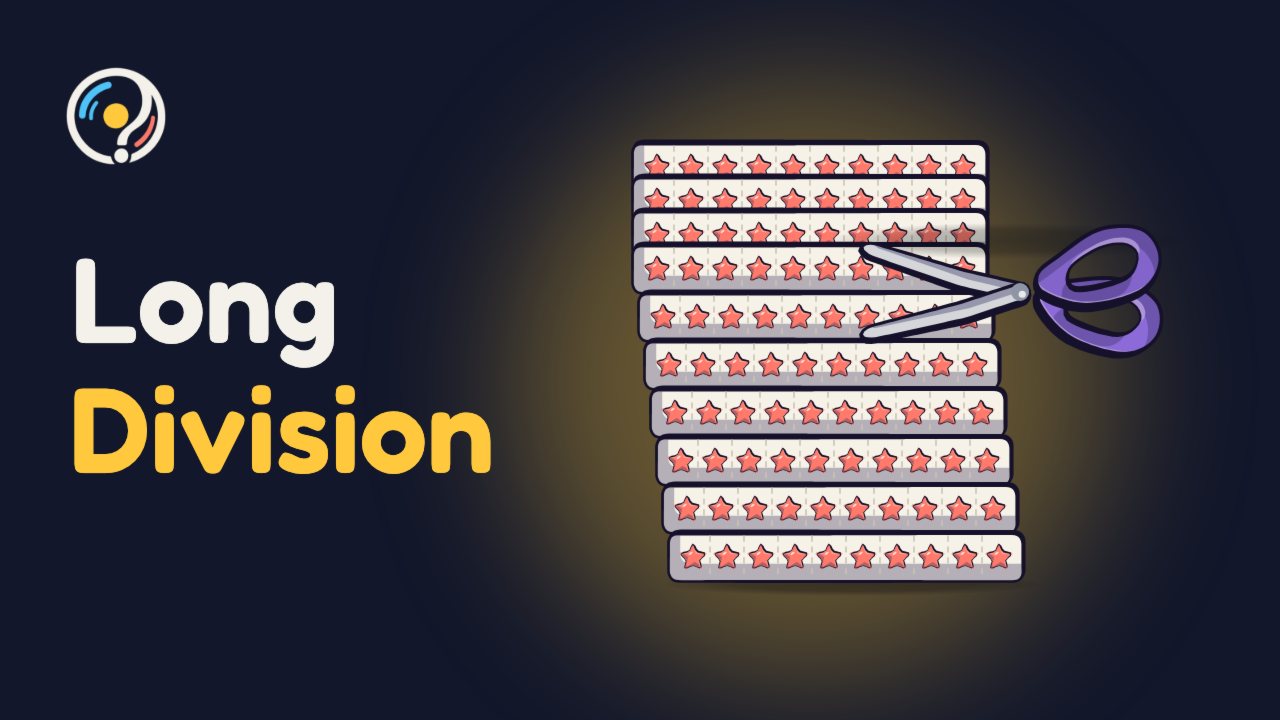
We share 745 stickers among 5 friends: sheets of 100, strips of 10 and single stickers. Each friend gets one sheet; the 2 leftover sheets get cut into 20 strips and join the 4 strips already there. That's what "bring down" means. Then we write the same sharing the long division way (divide, multiply, subtract, bring down), see why it starts on the left, check the answer by multiplying, meet the remainder, and show partial quotients, the way many schools teach it, as the same idea.
New word: quotient
Free lesson pack
A printable PDF for class or home: teacher guide, a hands-on activity, student worksheet, discussion questions, a six-question quiz, and the answer key.
Download the lesson pack (PDF)
Grades 4–6 · Common Core 4.NBT.B.6, Common Core 6.NS.B.2
Full transcript
Hook
Seven hundred forty-five stickers. Five friends. Everyone should get the same. Long division says one hundred forty-nine each. But all that dividing, multiplying, subtracting, and bringing down… why does it work?
Puzzle
Here's what's weird. When you add, you start on the right, with the ones. Long division starts on the left, with the biggest digit. Why backwards? And when you "bring down" a number, what are you really bringing? Lots of people learn these four steps and never find out why. Let's find out, with real stickers.
Zoom In
Stickers come in three sizes. A sheet has one hundred. A strip has ten. And a single is one. So seven hundred forty-five is seven sheets, four strips, and five singles. Start with the biggest pieces. Seven sheets, five friends. Each friend gets one sheet. That used five sheets. Seven take away five leaves two. Two sheets can't go around five friends. So cut them up! Two sheets make twenty strips. Add the four strips we already had. Twenty-four strips. That's what bring down means. The leftovers get cut into the next size, and join the next pile. Twenty-four strips, five friends. Four strips each. That uses twenty, and four are left. Cut those four strips into forty singles. Add the five singles. Forty-five. Forty-five singles, five friends. Nine each. Nothing left over. Each friend gets one sheet, four strips, and nine singles. One hundred forty-nine.
Try One With Me
Now let's write it the long division way, right next to the stickers. Divide. Seven sheets for five friends: one each. Write one on top. Multiply. One times five is five sheets used. Subtract. Two sheets left. Bring down the four. That's the cut-up sheets joining the strips. Twenty-four. Divide, multiply, subtract, bring down. Then do it again with the next size. So that's why we start on the left. Leftovers only flow down to smaller pieces. Start with the singles, and the cut-up sheets would make new singles to share all over again. The answer to a division has a name. The quotient. Your school might write it another way, called partial quotients. One hundred each, then forty, then nine. Same sharing, same answer. So if a grown-up learned it the other way, show them the stickers. It's the same idea.
Why It Matters
Want to check your answer? Multiply back. One hundred forty-nine times five is seven hundred forty-five. Every sticker is shared. You'll use this every time something big gets shared fairly. Splitting a pizza bill. A bag of candy for the class. A long road trip into days. What if there were seven hundred forty-six? One single would be left that can't be split five ways. That's the remainder. And the same steps work for any number, however big. Just share the biggest pieces first.
One-Line Recap
Share the biggest pieces first, and cut the leftovers into the next size down. Next time: how to do ratios.