
Why Do You Multiply Fractions Straight Across?
The short answerThe bottoms count all the pieces, and the tops count the pieces you keep.
Premieres Wed, October 14, 4 PM PT
Watch on YouTube · Episode 006
What the video explains
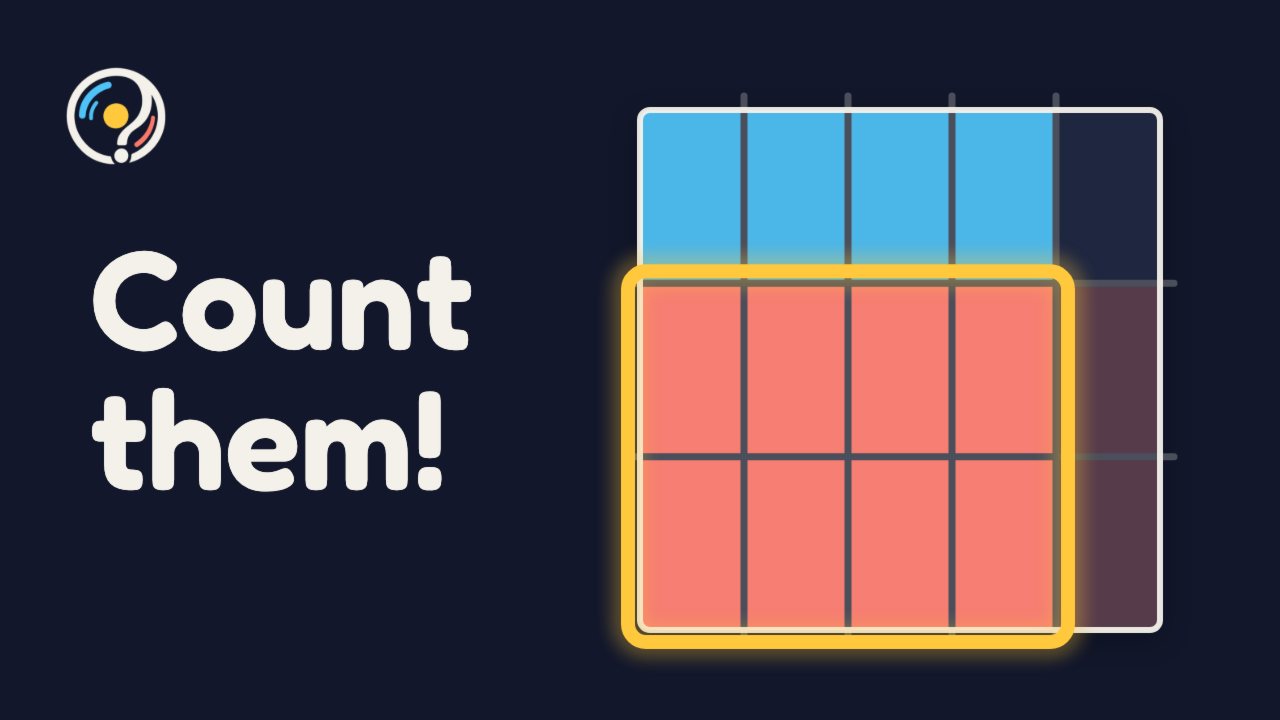
With fractions, "times" means "of." Two thirds times four fifths means two thirds of four fifths. Cut a square into 5 strips and 3 rows: the whole is 3 × 5 = 15 pieces, and the part you keep is 2 × 4 = 8 pieces. That's 8/15, the same answer as multiplying straight across. We also see why adding fractions needs matching bottoms, and share a chocolate bar.
New word: area model
Free lesson pack
A printable PDF for class or home: teacher guide, a hands-on activity, student worksheet, discussion questions, a six-question quiz, and the answer key.
Download the lesson pack (PDF)
Grades 5–7 · Common Core 5.NF.B.4, Common Core 5.NF.B.6
Full transcript
Hook
Two thirds times four fifths. Here's the rule: multiply straight across. Two times four is eight. Three times five is fifteen. Eight fifteenths. Easy. But why does that work?
Puzzle
Here's what's strange. Try that with adding, and it breaks. One half plus one half is one whole. Two halves of a pizza make a whole pizza. Add straight across, and you get two fourths. But two fourths is only half a pizza! So adding needs matching bottoms. Multiplying doesn't. What's different? Here's another surprise. One half times one half is one fourth. The answer got smaller! Times usually makes things bigger. So what does times really mean with fractions?
Zoom In
Three times four means three groups of four. Twelve. Now try one half times eight. That's half of eight. Four. So with fractions, times means "of." One half times one half means half of a half. Here's a square. It's one whole. Cut it in half, and shade one half. Now take half of that half. Cut across, and keep one part. Half of a half is one of four pieces. One fourth. That's why the answer got smaller. You took a piece of a piece. Now the hook problem. Two thirds of four fifths. First, four fifths. Cut the square into five strips. Shade four. Now take two thirds of that. Cut across into three rows. Keep two.
Aha
Now let's count. How many pieces is the whole square cut into? Five strips, three rows. Three times five. Fifteen. That's the bottom number. And how many pieces did we keep? Four across, two rows. Two times four. Eight. Eight fifteenths. The same answer as straight across! The tops multiply because they count the pieces you keep. The bottoms multiply because they count all the pieces the whole got cut into. This picture has a name. An area model. Now adding makes sense too. Adding puts pieces side by side, so they must be the same size first. Multiplying cuts pieces into smaller pieces. So the cuts multiply too.
Why It Matters
Here's where you'd use it. A chocolate bar has two rows of four squares. You have three fourths of it. Your friend asks for half of your piece. Half of three fourths. One half times three fourths. Straight across: three eighths. Check it on the bar. Half your piece is one row of three. That's three squares out of eight in the whole bar. What if you added instead? One half plus three fourths is more than a whole bar. That's more chocolate than you have! So when you need a part of a part, multiply. And the picture always shows you why.
One-Line Recap
The bottoms count all the pieces, and the tops count the pieces you keep. Next time: why is the ocean salty?