
Why Is the Sky Blue?
The short answerThe sky is blue because air scatters blue sunlight all across the sky.
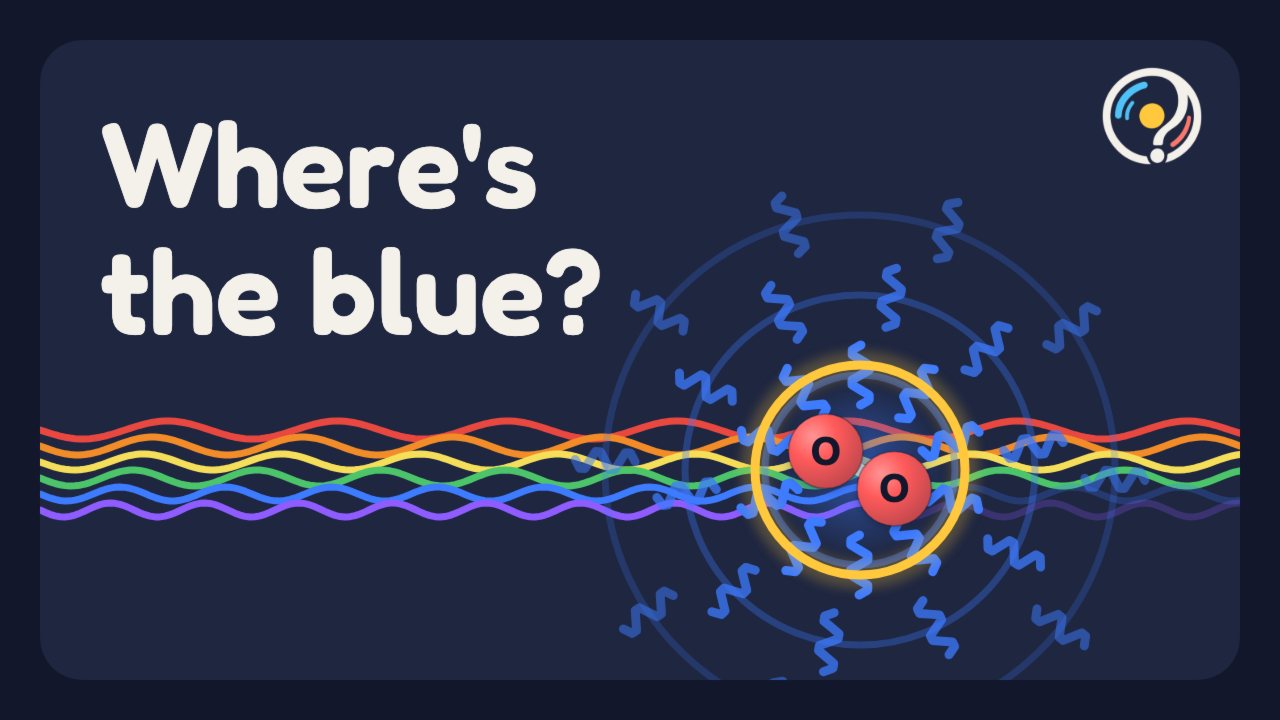
Premieres Sun, October 11, 4 PM PT
Watch on YouTube · Episode 005
What the video explains
Sunlight looks white, but it's really every color mixed together, and each color travels as a wave. The tiny molecules in air are much better at scattering short blue waves than long red ones, so blue light comes at you from every part of the sky. We also answer "why not violet?", see why sunsets turn orange and red, and visit the Moon, where there's no air and the daytime sky is black.
New word: scattering
Free lesson pack
A printable PDF for class or home: teacher guide, a hands-on activity, student worksheet, discussion questions, a six-question quiz, and the answer key.
Download the lesson pack (PDF)
Grades 4–8 · NGSS 4-PS4-2, NGSS MS-PS4-2
Full transcript
Hook
Look up on a sunny day. Blue. Bright blue, from one side of the sky to the other. But the sun doesn't shine blue light at you. Its light looks white. So why is the sky blue?
Puzzle
Here's what makes it weird. Air is see-through. A glass full of air has no color at all. If air were blue, your room would look blue too. And look at space. It's black, even right next to the sun. Maybe the sky is reflecting the ocean? Nope. The sky is just as blue over a desert. The answer is hiding in two places. Inside sunlight, and inside the air. Let's zoom in.
Zoom In
First, sunlight. Shine it through a prism, and something amazing happens. It spreads into a rainbow. Raindrops can split sunlight the same way. White light is really all the colors mixed together. Every color travels as a wave. Red light has long, stretched-out waves. Blue light has short, bunched-up waves. Now the air. Air is made of tiny molecules, mostly nitrogen and oxygen. They're spread far apart. And each one is much, much smaller than one light wave.
Aha
Watch what happens when sunlight passes through the air. The red waves mostly go straight past. But when blue waves hit a molecule, they get sent off in every direction. Tiny molecules are much better at doing this to short waves than to long ones. So blue gets bounced around far more than red. This has a name. Scattering. Now stand on the ground. Light from the sun comes straight at you. But the scattered blue comes at you from every part of the sky. Look anywhere, and you're seeing scattered blue light. That's the blue sky. A glass of air is too thin to notice. But the sky is miles and miles of air. Wait. Violet waves are even shorter. So why isn't the sky purple? Two reasons. The sun sends out less violet than blue. And your eyes are much better at seeing blue. So all that scattered light mixes together. And to your eyes, it looks sky blue.
Why It Matters
Scattering paints sunsets, too. At sunset, sunlight comes in low and sideways. It has to cross much more air to reach you. Along the way, most of the blue gets scattered out. The longer the trip, the more blue gets lost. What's left is yellow, orange, and red. And what if there were no air at all? Here's the Moon, at noon. No air, nothing to scatter the light. The sky is black, even with the sun out. Astronauts saw it for themselves: a black sky, with the sun blazing in it.
One-Line Recap
The sky is blue because air scatters blue sunlight all across the sky. Next time: why do you multiply fractions straight across?